
The Em Dash Isn’t New: A Brief History of the Hyphen, En Dash and Em Dash

Why are we talking about dashes?
There are few punctuation marks as controversial as the em dash. What was once a commonly used dash and a key tool in a writer’s toolkit is now seen as a telltale sign of AI-generated writing. It’s not a new punctuation mark, though; in fact, writers have been using em dashes for centuries. Where do you think AI learnt to use them from?
The em dash has been used for hundreds of years alongside its family of dashes – the en dash and the hyphen. But why do these dashes have different names and what is their function?
The dash family
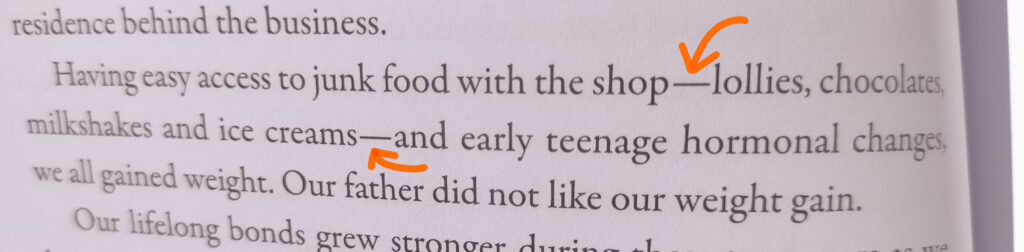
First, we have the longest and most controversial: em dash —
IMG Behind Closed Doors by Christine Elizabeth
The em dash is traditionally used to create a strong pause or emphasis on a point. It can be used to show an abrupt change, like when dialogue is cut off mid-thought. It can also be used to replace commas, parentheses or colons.
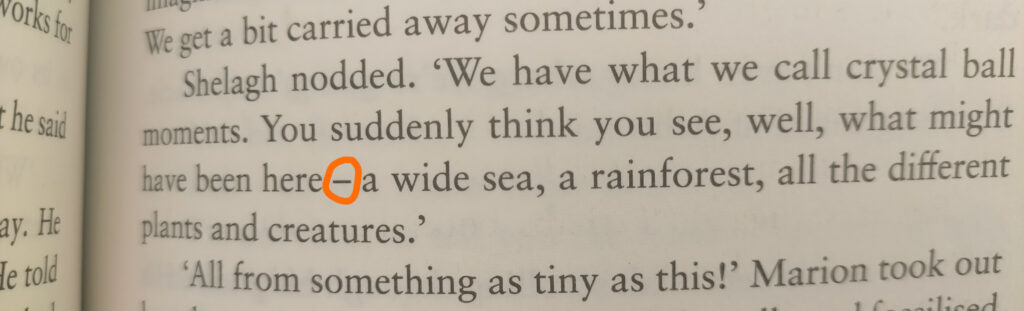
Next, we have the slightly shorter: en dash –
IMG The Endless Sky by Di Morrissey
The en dash was traditionally used to indicate a range of values, times or dates. It represents a relationship between the words, such as January–April or 2009–2013.
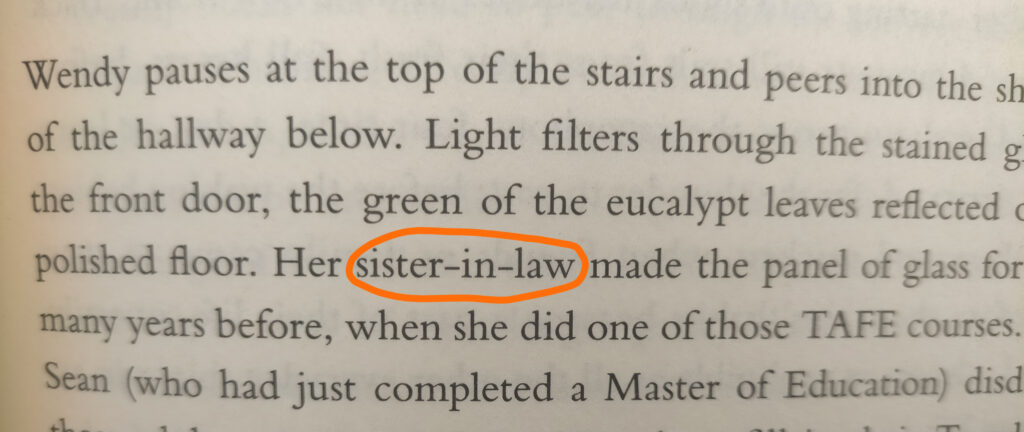
Lastly, we have the shortest of them all: the hyphen -
IMG A Short History of Longans by Mirandi Riwoe
The hyphen is used to join words or parts of words together, such as compound adjectives like short-term or well-known.
The use of the hyphen has not changed; it is still used today to join compounding words together. However, the use of the em dash and en dash has veered away from its original purpose.
Em dash or En dash?
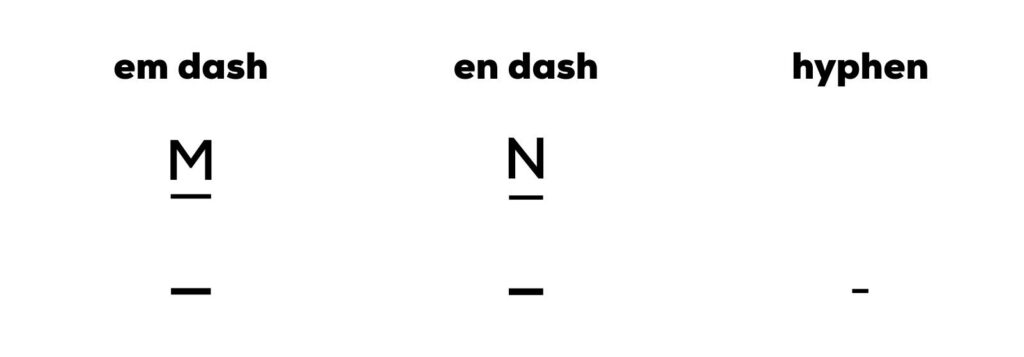
AI has caused great debate around the use of the em dash versus the en dash, but most readers have no idea of the difference, if any, or why this debate has become so heated.
It has become common for readers to see an unspaced em dash as a sure sign AI has written the content. The reality, though, is that the em dash dates back to early printing in the 15th Century. It takes its name from the width of the capital letter M in traditional typesetting.
Then came the typewriter era. Most typewriters lacked a dedicated em dash key, so writers often typed two hyphens instead or simply used a single hyphen as a substitute.
Closed VS spaced dashes
Once you know which dash you are using, you then need to know if it should be closed or spaced. Who knew dashes could come with so many rules to consider? Generally, em dashes are closed (no space between the words and the dash), while en dashes are spaced. However, just as the use of the em vs en dash is changing, so too is the closed and spaced rules. Styles can vary depending on the industry and country you’re in.
Traditionally, American publishers have favoured the closed em dash for dramatic pauses. Whereas British and Australian publishers more often prefer to use the shorter spaced en dash instead of an em dash to do the same job. However, when the en dash is used in a range in British and Australian publications, it is closed. This creates a difference between the closed and spaced en dash.
Academic style guides like The Chicago Manual of Style tend to use closed em dashes, while journalism prefers a spaced em dash for publications like newspapers and magazines.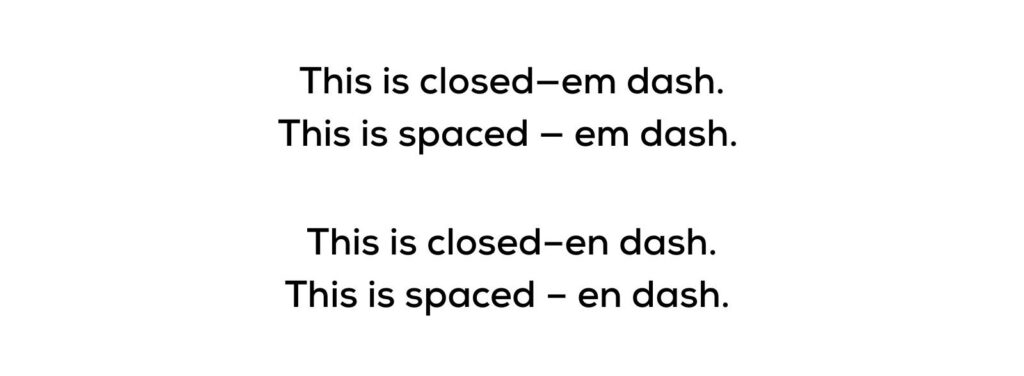
The same punctuation mark can have different meanings and uses depending on the style guide, making it difficult for writers to keep up with the changing publishing market. Meaning sometimes the answer to “which is correct?” is simply … it depends.
So why the outcry when the em dash has been part of written language for centuries?
The simple answer is that AI models tend to use em dashes frequently and consistently. That can make them a clue that AI has been involved, but it is certainly not proof. Plenty of experienced writers have used em dashes long before AI existed, so I’d encourage you to read the content before making an automatic judgement.
A punctuation mark cannot tell you who wrote a piece of text; sometimes an em dash in writing doesn’t mean they used AI. It simply means they used an em dash. Someone who has used em dashes throughout their writing career hasn’t suddenly become an AI writer because the technology has taken control of the punctuation mark. AI didn’t invent the em dash; people did.
The hyphen
While we’re on the topic of dashes, there is one thing that often gives away a self-published book, and that’s the use of a spaced hyphen instead of a dash. Many new authors simply aren’t aware of the differences, so if you’re self-publishing, this is one small detail worth looking for during your self-edit.
It’s a tiny piece of punctuation, but it’s one of those details that can quietly lift the professionalism of your manuscript.
Five myths about dashes
These are five punctuation myths that writers and readers often believe but are wrong.
Myth 1: The em dash is an AI punctuation mark.
Reality: It predates modern AI by centuries.
Myth 2: The en dash and em dash are interchangeable.
Reality: They have different traditional functions.
Myth 3: There is only one correct way to space an em dash.
Reality: There are different style guides depending on your country and industry.
Myth 4: Good writers don’t use lots of dashes.
Reality: The use of dashes is a matter of style, context and convention.
Myth 5: Punctuation rules never change.
Reality: Punctuation conventions are evolving continually. Remember when the Oxford comma changed the rules?
A practical guide
When you’re staring at the keyboard next – wondering if you should use a hyphen, en or em dash – ask yourself what job you need it to perform. Don’t choose it because it looks right; choose it because it helps explain your sentence and what you’re trying to say. Something as simple as a punctuation mark has the strength to alter the rhythm of your writing.
Punctuation marks may be tiny, but they carry a surprising amount of history. The hyphen, en dash and em dash have travelled from manuscripts written with typewriters to files typed on keyboards. They’ve been through printing presses and saved in our digital files. Their forms and conventions have changed along the way, just as language itself has changed.
So, the next time you see an em dash, instead of wondering if it was written by a human or machine, ask a much more interesting question: what is the writer using it to say?
Dettori Publishing
If you are feeling overwhelmed by the self-publishing process, check out our free resources.
